
Comparing Sheffield to Other UK Greyhound Tracks: How Owlerton Stacks Up
Best Greyhound Betting Sites – Bet on Greyhounds in 2026
 Available in US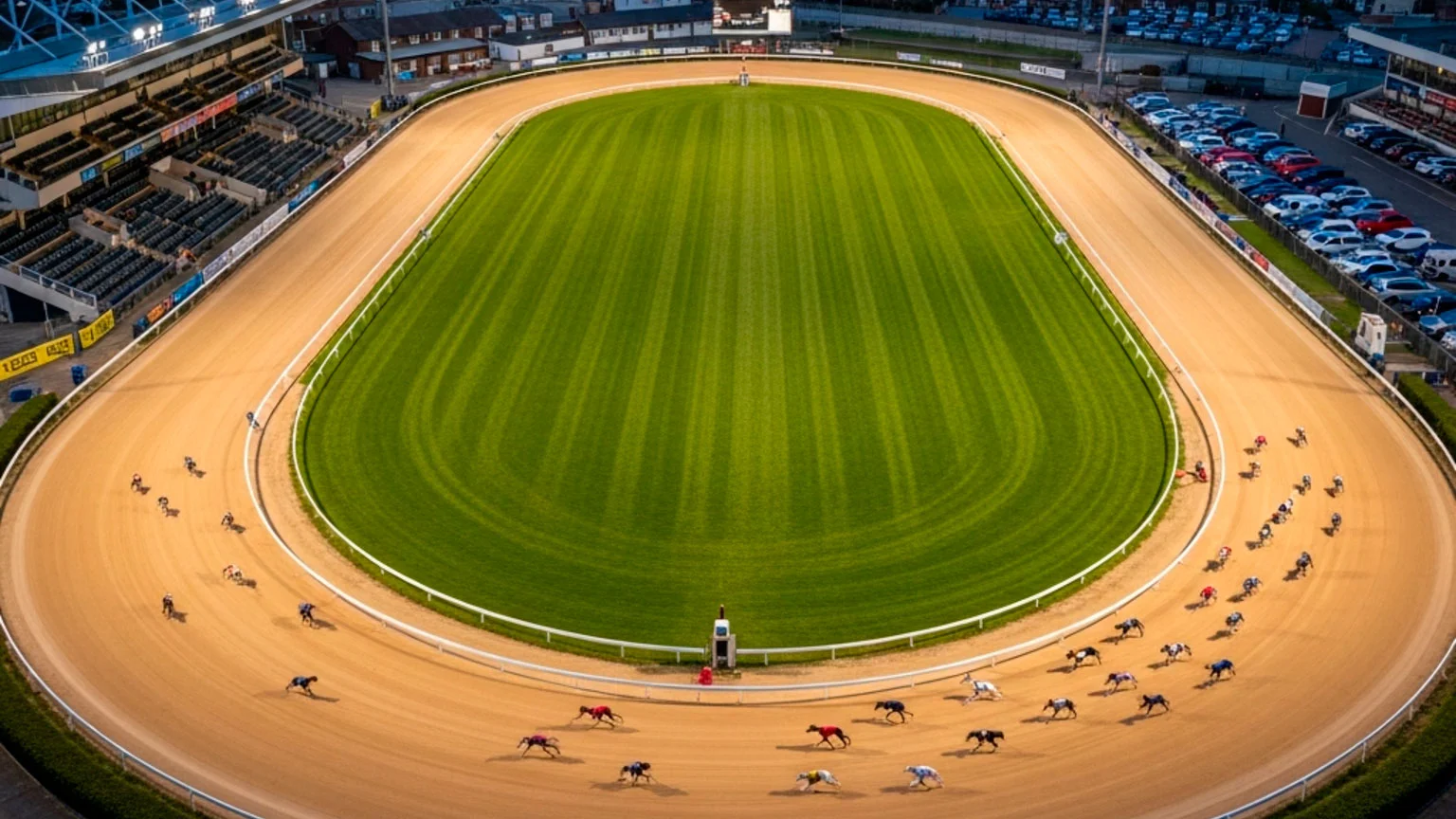
Comparing Sheffield greyhound track to its counterparts across Britain is not an exercise in ranking — it is a practical necessity for anyone who bets on dogs at more than one venue. Owlerton has a specific geometry, a specific surface, and a specific set of distances that produce a specific type of racing. A dog that excels at Sheffield may struggle at Romford. A dog transferred from Nottingham may need several runs to adjust to Owlerton’s tighter bends. Understanding these differences is what separates track-specific form analysis from the kind of generic approach that treats all GBGB stadia as interchangeable.
As of early 2025, there are 18 GBGB-licensed stadiums operating in Britain. Each has its own dimensions, its own distances and its own character. Sheffield sits among the mid-sized tracks — not the biggest, not the smallest, but distinctive enough in its combination of features to require track-specific knowledge from any punter who takes it seriously.
Comparing Sheffield to Other UK Greyhound Tracks — More on this topic at sheffield greyhound results.
Circumference, Bends and Run-Up: Sheffield vs the Rest
The most important dimension for comparing tracks is circumference. Owlerton’s circuit measures 425 metres, which places it in the middle tier of GBGB tracks. Larger circuits like Towcester and Nottingham offer wider bends and longer straights, which produce faster times and suit galloping dogs that need room to stretch out. Smaller circuits like Crayford and Romford have even tighter bends than Sheffield, creating racing where trap position and early pace dominate almost completely.
The run-up distance — the length of straight between the starting traps and the first bend — is arguably more important than circumference for predicting how a race will unfold. At Sheffield, this distance is approximately 62 metres. That is shorter than Nottingham, where the run to the first bend is considerably longer and gives outside runners more time to find a position, but longer than tracks like Romford where the first bend arrives almost immediately after the traps open. The 62-metre run-up at Owlerton creates a balanced dynamic: inside traps have a geometric advantage through the first bend, but the straight is long enough that a sharp-breaking outside runner can sometimes overcome that disadvantage.
Bend radius — how sharp or gradual the turns are — is the third key dimension. Sheffield’s bends are relatively tight, a consequence of fitting the circuit into the available space at the Penistone Road site. Tighter bends scrub more speed, penalise wide-running dogs more severely, and amplify the importance of trap draw. At wider tracks like Towcester, the bends are more gradual, allowing dogs to maintain speed through the turns and reducing the advantage that inside runners enjoy. When a dog moves from a wide track to Sheffield, the adjustment to tighter bending is one of the first things that shows up in its form — it may run wider than usual, lose ground through the turns, and post a slower time than its previous track form suggested was likely.
These dimensional differences mean that times at one track are not directly comparable to times at another. A 29.00-second 500 metres at Sheffield and a 29.00 at Nottingham are different performances, achieved on different circuits with different characteristics. The only fair comparison is between times set at the same track, under similar conditions. This is a basic principle of greyhound form analysis, but it is one that punters who follow multiple tracks frequently overlook.
Which Tracks Offer Similar Distances to Owlerton
Sheffield’s nine-distance menu is unusually extensive. Most GBGB tracks offer four to six distances as standard, with a few venues stretching to seven or eight. Owlerton’s full range — 280, 362, 480, 500, 660, 720, 800, 915 and 934 metres — covers everything from pure sprints to genuine marathons, giving the track a versatility that few competitors can match.
The standard distances of 480 and 500 metres are available at almost every GBGB track, so form comparisons at these trips are the most straightforward. If a dog has posted strong 480-metre times at Monmore or Sunderland, you can at least benchmark those against Sheffield 480-metre form, adjusting for the differences in track geometry. Sprint distances vary more widely between tracks — not all venues offer a 280-metre race, and those that do may run it over a different section of the circuit with a different bend configuration.
Staying distances are where Sheffield’s extensive menu becomes a genuine differentiator. The 720, 800 and 915-metre races at Owlerton cater to a niche that many tracks do not serve at all. Dogs bred and trained for marathon distances may have limited options beyond Sheffield, which can concentrate the best stayers at Owlerton and produce particularly competitive fields at these trips. For punters, this specialisation creates opportunities: if you develop expertise in Sheffield’s staying races, you are competing against a smaller pool of informed bettors than you would face in the standard-distance markets.
Trap Bias Differences Across UK Venues
Trap bias — the statistical advantage or disadvantage associated with each starting position — varies significantly between tracks, and understanding how Sheffield’s bias compares to other venues is essential for punters who follow multiple stadiums. Across all UK tracks aggregated together, Trap 3 shows a slight overall advantage in win percentage, though this average conceals enormous variation between individual venues.
At Sheffield, trap bias is shaped by the 62-metre run to the first bend and the tightness of the turns. Inside traps tend to perform well at sprint distances, where the shorter path through the first bend is decisive. At standard distances, the bias is less pronounced because the race is long enough for positional disadvantages at the first bend to be overcome. These patterns are specific to Owlerton and do not necessarily apply at other tracks with different geometries.
Tracks with longer run-ups tend to produce more evenly distributed trap statistics, because outside runners have more time to establish position before the first bend. Tracks with very short run-ups push the bias heavily towards inside traps at almost every distance. Sheffield sits between these extremes, which means the trap bias is present but not overwhelming — a factor that makes Sheffield racing more competitive and less predictable than venues where inside draw dominance is extreme.
The practical implication for punters who bet at multiple tracks is clear: you cannot transfer trap bias assumptions from one venue to another. A strong inside-draw bias at Romford tells you nothing about the draw at Sheffield. Each track’s bias must be studied independently, using track-specific data rather than generalised industry averages. The theoretical 16.6 per cent chance per trap in a six-runner race is the starting point; the track-specific data tells you how far each trap deviates from that baseline at the venue you are betting on.
Why Owlerton Has Its Own Racing Character
Every GBGB track has a personality, but Owlerton’s is particularly well-defined. The combination of a 425-metre circuit, nine distances, tight bends, a sand surface that changes with the weather, and a fixture list of 260-plus meetings per year creates a racing environment that rewards a specific kind of dog and a specific kind of analysis. Sheffield favours greyhounds that trap cleanly, handle tight bends without losing momentum, and show tactical awareness through crowded fields. Pure gallopers that need room to stride out are less suited to Owlerton than they are to larger circuits.
See also UK Greyhound Racing Industry in Numbers.
For punters, the character of the track defines the character of the form study required. Sheffield demands attention to trap draw, sectional times and going conditions in a way that wider, simpler tracks do not. It rewards the specialist — the punter who knows Owlerton inside out and can spot the nuances that a generalist following eight tracks simultaneously will miss. The track comparison exercise is useful precisely because it clarifies what makes Sheffield different, and difference is where analytical advantage lives.