
Sheffield Greyhound Betting: Odds, Markets and Owlerton Strategy
Best Greyhound Betting Sites – Bet on Greyhounds in 2026
 Available in US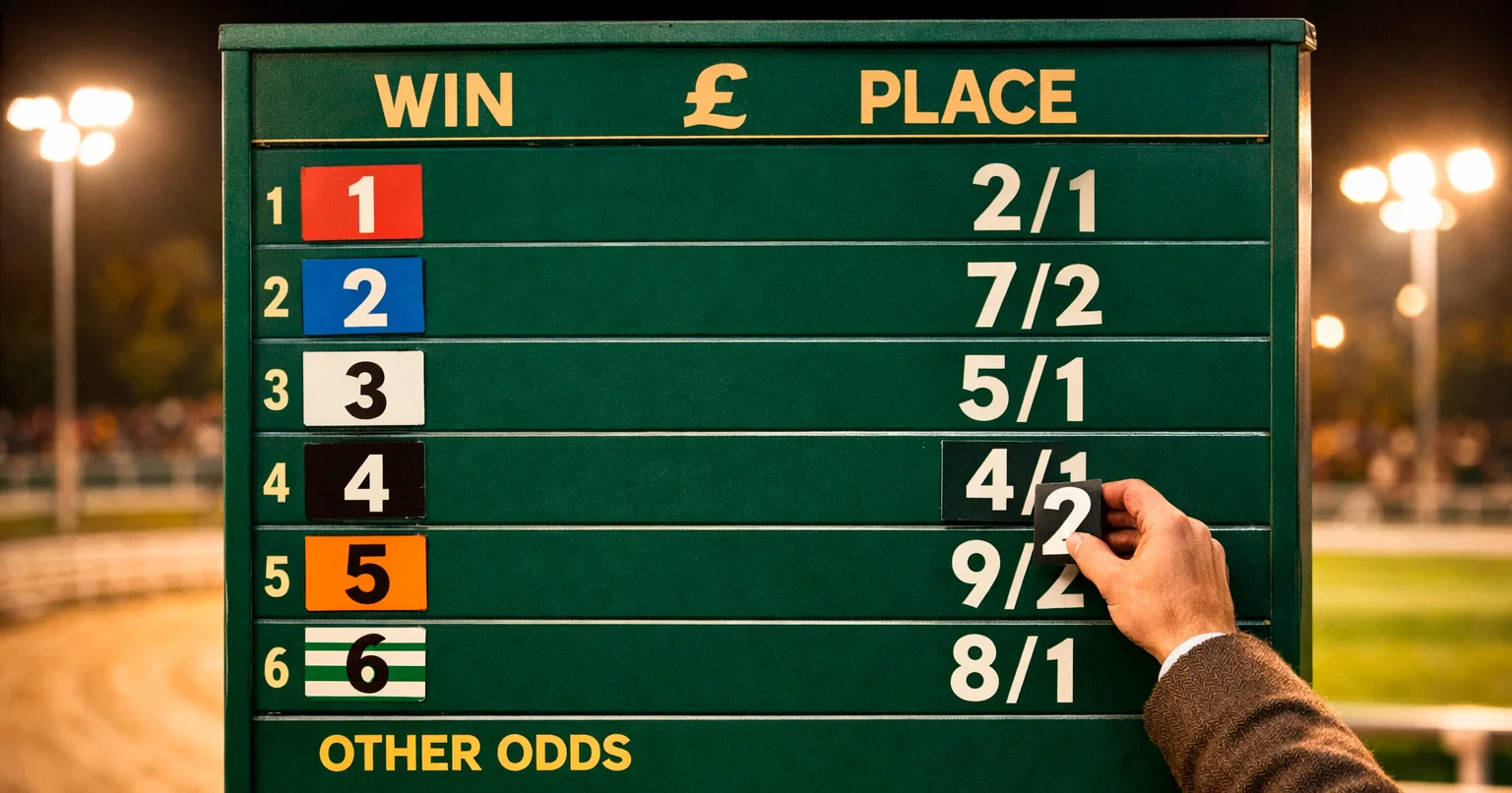
Sheffield greyhound betting is one of the most accessible entry points into racing wagering in the UK. With Owlerton Stadium staging more than 260 meetings a year, there is almost always a Sheffield card to bet on — weekday afternoons through SIS-broadcast BAGS meetings, Friday and Saturday evenings for the main public fixtures, and feature events like the Steel City Cup drawing entries and punters from across the country. The sheer volume of racing means opportunity, but opportunity without structure is just noise. This article is about building the structure.
The UK gambling industry generated £16.8 billion in gross gambling yield during the financial year ending March 2025, a figure that grew 7.3 percent year on year. Greyhound racing sits within that ecosystem as a sport with a dedicated betting audience, a regular fixture list, and markets that range from simple win bets to complex combination wagers. Whether you are placing a fiver on a Friday night favourite or working through the form with a view to backing a forecast, the markets at Sheffield cater to every level of engagement. What follows is a map of those markets, an explanation of how odds work, a comparison of the pricing mechanisms available to you, and a framework for approaching Owlerton meetings with a strategy rather than a hope.
Sheffield Greyhound Betting — More on this topic at sheffield greyhound results.
Betting Markets Available at Sheffield Greyhounds
The simplest and most popular market at any greyhound meeting is the win bet. You pick a dog, you place your stake, and if it crosses the line first, you collect. The payout depends on the odds at the time your bet is settled — either the price you took when you placed the bet (if you took an early or fixed price) or the Starting Price declared at the off. Win betting accounts for the majority of turnover on Sheffield cards, and for anyone new to greyhound racing, it is the logical place to start. One dog, one outcome, no complications.
Each-way betting splits your stake into two parts: half on the dog to win, half on the dog to finish in the first two (for six-runner races, the standard each-way terms are 1/4 odds for a place). If your dog wins, you collect on both halves. If it finishes second, you lose the win portion but collect the place portion at reduced odds. Each-way bets work well for dogs that you believe will be competitive but may not have the quality or the draw to win outright. The maths is important here: for an each-way bet to be profitable on the place part alone, the implied probability of the dog placing needs to be higher than the price suggests. At short odds, each-way rarely offers value. At bigger prices — 5/1 and upward — it becomes a more interesting proposition.
Forecast betting is where greyhound markets diverge from most other sports. A straight forecast requires you to predict the first and second dog in the correct order. A reverse forecast covers both possible orderings — your two selections finishing first and second in either sequence — for double the stake. The returns on forecast bets can be substantial because you are predicting a more specific outcome. A typical Sheffield forecast dividend might range from £10 to £50 for a £1 stake, though longer-priced outcomes occasionally produce much larger returns. The forecast dividend is calculated by the Computer Straight Forecast formula rather than fixed at the time of betting, which means the payout reflects the actual Starting Prices of the first two dogs. This calculation method can produce some counter-intuitive results, so it is worth understanding the mechanics before you commit regular stakes to forecast markets.
Tricast betting takes the specificity one step further: you predict the first three finishers in exact order. Combination tricasts cover all possible orderings of your three selections, which costs six times the unit stake (since there are six possible finishing orders for three dogs). Tricast dividends are typically much larger than forecast dividends — a winning tricast at Sheffield can return anywhere from £30 to several hundred pounds for a £1 stake — but the strike rate is correspondingly lower. Tricasts are high-variance bets that appeal to punters willing to accept long losing runs in exchange for occasional large payouts. They are not a sensible foundation for a betting strategy, but they have their place as a supplementary market for meetings where the form points to a specific finishing order with reasonable confidence.
The Tote operates at many greyhound meetings as an alternative to fixed-odds betting. Tote pools work on a parimutuel basis: all stakes go into a pool, the operator takes a percentage, and the remainder is divided among winning tickets. Tote win, forecast and tricast dividends sometimes differ significantly from their fixed-odds equivalents, and in races where the favourite is very short, the Tote can occasionally offer better returns for those backing longer-priced dogs. The trade-off is that you do not know the exact payout until after the race, because the dividend depends on the total pool and how it was distributed.
For feature events like the Steel City Cup, ante-post markets occasionally open in advance of the heats, allowing you to back a dog at an early price before the competition gets underway. Ante-post betting carries the risk that your dog might not reach the final — if it is eliminated in the heats or semi-finals, your stake is lost — but the prices are typically more generous than the day-of-race odds to compensate. This market is niche and only relevant for the handful of feature events on the Sheffield calendar, but for those who follow the sport closely enough to have a view on likely finalists, it offers a different kind of betting experience.
Understanding Greyhound Odds: Fractional, Decimal and Implied Probability
UK greyhound betting traditionally uses fractional odds — 3/1, 5/2, 7/4 and so on — and if you have grown up with them they feel intuitive. A dog at 3/1 returns £3 profit for every £1 staked, plus your stake back. A dog at 5/2 returns £2.50 for every £1. The top number is the profit, the bottom number is the stake. Simple enough in principle, though some of the more awkward fractions — 11/8, 100/30, 9/4 — require mental arithmetic that not everyone enjoys performing between races with a pint in hand.
Decimal odds, standard on betting exchanges and increasingly common at bookmakers, express the total return per unit staked. A dog at 4.0 decimal returns £4 for every £1, which includes your stake. The equivalent fractional price is 3/1. A dog at 3.5 decimal is 5/2 fractional. The advantage of decimal odds is that comparisons are immediate — 4.0 is obviously bigger than 3.5 — and calculations are straightforward multiplication. If you are using a betting exchange to back or lay Sheffield dogs, decimal is the native language and it is worth becoming fluent.
Implied probability is the analytical translation of odds into a percentage chance of winning. To convert fractional odds, divide the denominator by the sum of numerator and denominator: for 3/1, that is 1 ÷ (3+1) = 25%. For decimal odds, divide 1 by the decimal: 1 ÷ 4.0 = 25%. This number tells you what the market believes — or more precisely, what the odds imply — about the dog’s chance of winning. A dog at 25% implied probability is expected to win one in four races at that price. If your own assessment says the dog wins more often than that, the price represents value. If your assessment says less often, it does not.
The overround is where the bookmaker’s margin lives. In a six-dog race with a perfectly fair book, the implied probabilities of all six runners would sum to exactly 100%. In practice, they sum to more — typically somewhere between 115% and 135% on greyhound markets. The excess is the bookmaker’s built-in profit margin. A book percentage of 125% means that for every £100 theoretically wagered across all outcomes, the bookmaker expects to keep £25 before any other factors come into play. Higher overrounds mean worse value for the punter. Lower overrounds — found more often at betting exchanges or competitive online bookmakers — mean the market is giving you a fairer deal.
For a practical example, imagine a Sheffield race where the six dogs are priced at 2/1, 3/1, 4/1, 5/1, 8/1 and 10/1 in fractional terms. Converting to implied probabilities gives you 33.3%, 25.0%, 20.0%, 16.7%, 11.1% and 9.1%, which sums to 115.2%. The overround is 15.2%, which is moderate for a greyhound market. If you believe one of those dogs has been underestimated — if your form analysis puts a 4/1 shot closer to a 3/1 chance — then the market is offering you value on that selection, even after accounting for the bookmaker’s margin. This kind of price comparison is the fundamental mechanism by which informed punters find profitable bets over time.
SP vs BSP: Which Price Should Sheffield Bettors Take?
The Starting Price — SP — is the traditional pricing mechanism in UK greyhound racing. It is the price at which a dog starts the race as determined by the on-course market, and it is the default settlement price for bets placed without taking a fixed price. SP is compiled by an official who assesses the available prices from on-course bookmakers at the moment the traps open. For decades, this was the only price that mattered. If you walked into a betting shop and put a slip on a dog, your bet was settled at SP unless you specifically requested otherwise.
The Betfair Starting Price — BSP — is a more recent alternative, generated by the betting exchange’s matching algorithm. BSP is calculated from the unmatched bets in the exchange market at the off time, producing a price that reflects the genuine supply and demand of exchange users rather than the assessment of a small number of on-course bookmakers. Because the exchange market typically involves more participants and more money than the on-course ring at a greyhound meeting, BSP can sometimes produce a more efficient — which often means more generous — price than the traditional SP.
The practical difference between the two prices varies by race and by dog. For short-priced favourites, SP and BSP tend to converge. The market agrees on the probability, and there is little room for divergence. For longer-priced runners, BSP often offers better value because the exchange market is less susceptible to the conservative pricing that on-course bookmakers apply to protect their margins on outsiders. If you regularly back dogs at 5/1 or bigger, comparing BSP to SP over a sample of bets will frequently show BSP coming out ahead.
The UK’s network of 5,825 licensed betting shops remains a significant channel for greyhound wagering, and the vast majority of in-shop bets are settled at SP. Online bettors have more flexibility: they can take an early fixed price offered by the bookmaker, request SP, or — if they use a betting exchange — take BSP. The choice depends on timing and confidence. If you see a price you like in the early markets and believe the dog will shorten before the off, taking the fixed price locks in value. If you think the dog might drift — if the market is likely to push its price outward as money comes in on other runners — then SP or BSP might deliver a better return.
There is no universal answer to which pricing mechanism is better. It depends on your betting style, the types of dogs you back, and the specific market dynamics of each race. What is universally true is that understanding the difference — and making a conscious choice rather than defaulting to whichever price your platform serves up — is a basic but important step towards more disciplined Sheffield greyhound betting.
Building a Betting Approach for Owlerton Meetings
Strategy in greyhound betting is not about finding a system that wins every time. It is about developing a repeatable process that identifies value — situations where the odds offered by the market are more generous than the true probability of the outcome — and exploiting that value consistently over a large number of bets. At Sheffield, where the racing calendar delivers more than 260 meetings per year, the sample size for any disciplined approach is enormous. That is an advantage. Over a small number of bets, luck dominates. Over thousands, process dominates.
The foundation of any Sheffield-specific strategy is form analysis. Favourites win approximately 30 to 40 percent of greyhound races, and the top three in the market produce the winner around 73 percent of the time. Those numbers tell you two things. First, the market is reasonably efficient — the shortest-priced dog wins more often than any other single dog. Second, the market is far from perfect — the favourite loses more often than it wins, and in more than a quarter of races the winner comes from outside the top three in the betting. The gap between market efficiency and market imperfection is where profitable betting lives.
At Owlerton, several track-specific factors feed into a sharper strategy. Trap draw is one: the 62-metre run to the first bend creates a pattern of trap bias that varies by distance and weather, and a bettor who understands that pattern can identify situations where a dog’s draw is either helping or hindering it in ways the market may not fully price in. Distance suitability is another: Sheffield’s nine distances mean dogs regularly switch between trips, and a dog stepping up from 480 to 660 metres — or dropping back from 660 to 480 — may be better or worse suited to the new distance than its overall form suggests. Trainer form, track conditions, and the quality of the competition round out the picture.
The UK greyhound industry distributes a total prize fund of approximately £15.7 million across its licensed tracks, and the financial structure of the sport influences racing patterns in ways that are relevant to bettors. Trainers are motivated to place dogs in races they can win — prize money matters to kennels, and so does the dog’s grading, which is affected by results. A trainer entering a dog in a race that plays to its strengths is making a rational economic decision, and recognising those decisions from the racecard is a skill worth developing. When you see a dog dropping in grade, switching distance, or moving to a trap that suits its style, those are signals that the connections believe conditions are right for a performance.
Mark Moisley, Commercial Director of the Greyhound Board of Great Britain, has made the case that the sport contributes £164 million annually to the UK economy and employs 5,400 people, while arguing that greater financial support from bookmakers through a compulsory levy is needed to secure the sport’s future. For bettors, the funding debate is less immediately relevant than the racing itself, but it provides context: the commercial relationship between bookmakers and greyhound tracks shapes which meetings are staged, which races are broadcast, and ultimately which betting markets are available. The 260-plus meetings at Sheffield exist in large part because of the BAGS contract with bookmakers, which funds the fixtures that populate your Tuesday afternoon card. Understanding the commercial structure helps you understand why certain types of racing appear at certain times — and that understanding, in turn, helps you decide which meetings are worth your analytical effort and which are better left alone.
Staking and Bankroll Discipline for Greyhound Bettors
You can have the best form analysis in the world and still lose money if your staking is undisciplined. This is the part of betting that people least want to hear about, because it is not exciting and it does not involve studying racecards. But it is the part that determines whether your Sheffield greyhound betting is sustainable or whether it burns through your budget in a bad month.
See also Greyhound Welfare and Rehoming at Sheffield.
The concept of a bankroll is straightforward: it is the total amount of money you have set aside for betting, separate from money you need for rent, bills, food and everything else in your life. The bankroll is not your savings account. It is not money you cannot afford to lose. It is a defined sum that you are prepared to risk on greyhound betting over a given period, with the understanding that it might grow, it might shrink, and in a bad run, it might disappear entirely. If losing your bankroll would cause you genuine financial distress, it is too large. Resize it until losing it would be disappointing but not damaging.
Level staking is the simplest and most robust approach. You bet the same amount on every selection regardless of how confident you feel. If your bankroll is £500 and you decide your unit stake is £5, you place £5 on every bet. The advantage of level staking is that it removes emotion from the staking decision. When you have found a dog you love at a price you think is generous, the temptation is to pile in. Level staking stops you. When you are chasing a losing run and want to increase your stake to recover, level staking stops you again. The discipline is the point.
Percentage staking is a more sophisticated alternative. Instead of a fixed amount, you stake a fixed percentage of your current bankroll on each bet — typically between 1% and 3%. If your bankroll is £500 and you stake 2%, your first bet is £10. If you win and the bankroll grows to £540, your next bet is £10.80. If you lose and the bankroll drops to £460, your next bet is £9.20. The system automatically adjusts your exposure to match your current position: you bet more when you are winning and less when you are losing. This makes it almost mathematically impossible to go broke in a single bad run, which is the single biggest advantage of percentage staking over flat staking.
Session management matters at greyhound meetings because the format — twelve races over a couple of hours — creates natural opportunities to over-bet. If you attend a Friday night at Owlerton and bet on every race, you are placing twelve bets in a single session. At £5 per bet, that is £60 at risk. At £10 per bet, it is £120. Over a month of Friday nights, the cumulative exposure is significant. Not every race on a card will contain a selection that meets your criteria. Learning to sit out races where the form is unclear or the value is absent is one of the most important skills a greyhound bettor can develop. Betting on eight races instead of twelve does not feel like a strategy, but it is.
Record-keeping is the final piece. Write down every bet — the date, the meeting, the race, the dog, the trap, the odds, the stake, and the result. This sounds tedious and it is, but it serves two purposes. First, it gives you an honest account of your betting performance. Most people overestimate their winners and underestimate their losers. A written record corrects that. Second, it allows you to identify patterns in your own decision-making: are you profitable at certain distances but not others? Do you do better on Saturday evenings than midweek afternoons? Is your strike rate on forecast bets genuinely positive, or does it just feel that way because you remember the big wins and forget the long dry spells? Data about your own betting is as valuable as data about the dogs.
None of this is glamorous. Bankroll management does not produce the rush of a winning tricast or the satisfaction of calling a 5/1 shot. What it produces is longevity — the ability to keep betting at Sheffield week after week, month after month, without the financial damage that comes from undisciplined staking. In a sport where the edge is small and the variance is large, longevity is the only thing that turns a good process into a good outcome.