Sheffield Greyhound Racecards: Where to Find Them and How to Use Them
Best Greyhound Betting Sites – Bet on Greyhounds in 2026
Loading...
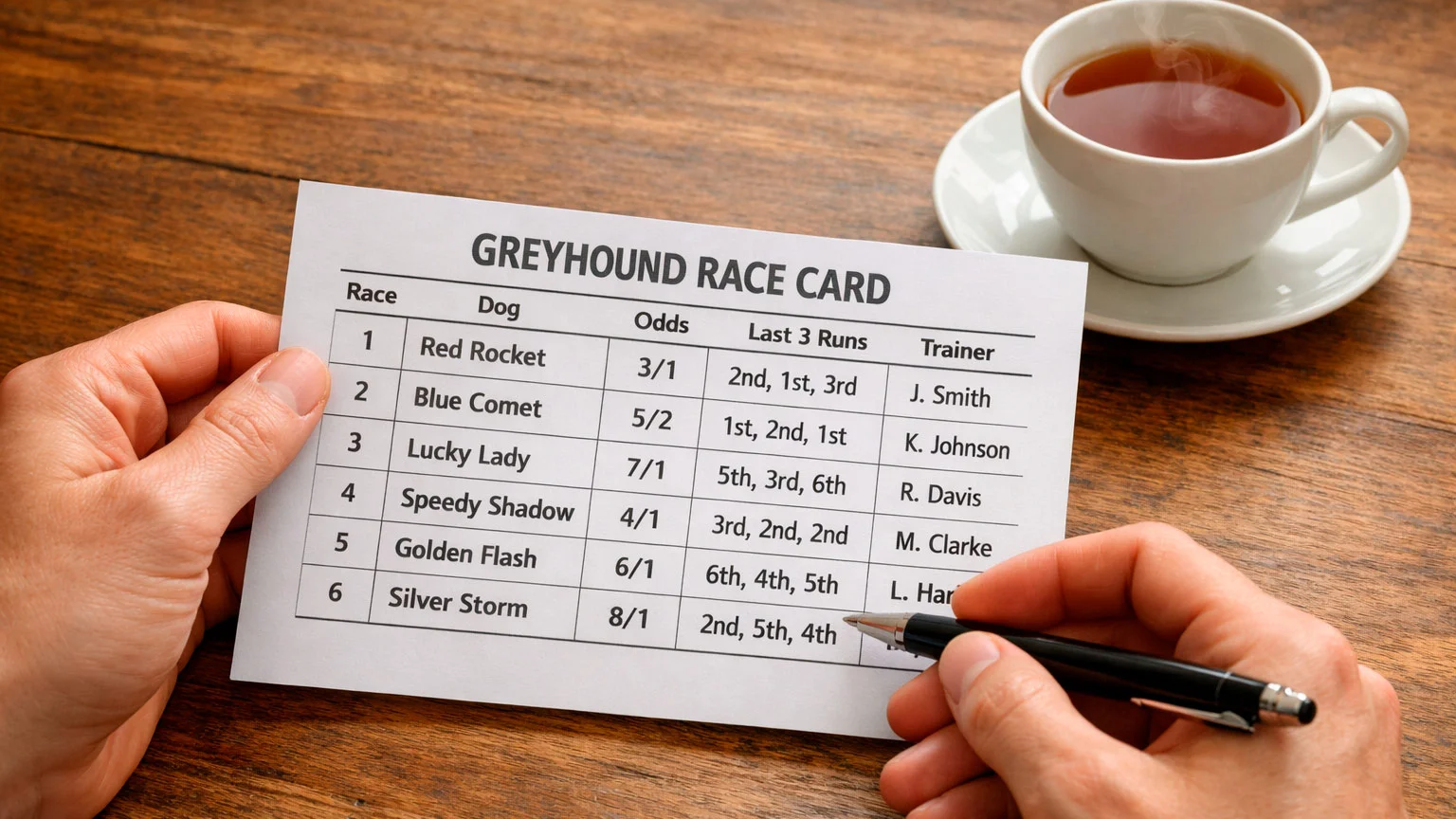
Sheffield greyhound racecards are the starting point for any informed bet at Owlerton Stadium. Before you look at odds, before you check the going, before you consider trap positions — the racecard is where the raw material sits. It lists every runner in every race, alongside the data that trainers, tipsters and serious punters use to separate contenders from passengers. Knowing where to find these cards and, more importantly, how to read them is a basic requirement for anyone who wants to approach Sheffield greyhound racing with something more than gut instinct.
Owlerton hosts more than 260 meetings per year, which means fresh racecards appear with a regularity that few other sporting venues can match. On any given week, there might be four or five cards to study. That volume is both an opportunity and a challenge: the data is plentiful, but it takes practice to extract value from it efficiently. The good news is that the structure of a greyhound racecard is standardised across GBGB-licensed tracks, so once you learn to read a Sheffield card, you can read any racecard in British racing.
Online Sources for Sheffield Racecards
The shift from printed racecards to digital ones happened gradually across UK greyhound racing, but by 2026 the process is essentially complete. Sheffield racecards are available online from several sources, each with slightly different levels of detail and presentation. Knowing which to use — and when — can save time and improve the quality of your analysis.
At The Races is one of the most widely used racecard platforms for greyhound racing in Britain. It provides Sheffield cards with full form lines, trainer details and recent performance data, typically published the day before a meeting. The interface is familiar to anyone who follows horse racing, which makes the transition straightforward if you are coming from the flat or jumps world.
Sporting Life offers a similarly comprehensive racecard service, with the added benefit of integrating odds from multiple bookmakers alongside the form data. For punters who want to compare market assessments with their own analysis, this side-by-side presentation is useful. The RPGTV website and the SIS Racing data feeds also carry Sheffield racecards, though these tend to be most useful in conjunction with live coverage rather than as standalone research tools.
The Owlerton Stadium website itself publishes cards for upcoming meetings, often with additional context about the meeting type — whether it is a BAGS fixture, an open meeting, or a feature event. With over 260 meetings annually, the supply of Sheffield racecards is near-constant, and there is rarely a week without new data to examine. For serious students of Sheffield form, the habit of checking cards daily rather than waiting for a race you plan to bet on pays dividends over time, because patterns in trainer behaviour, distance switches and grading changes reveal themselves through consistent observation rather than one-off analysis.
Breaking Down Each Column on the Racecard
A greyhound racecard is more compressed than its horse racing equivalent, but it contains a surprising density of information once you know what each column represents. The layout varies slightly between providers, but the core data fields are consistent across all GBGB cards.
The trap number tells you the starting position, from 1 (red, innermost) through 6 (black, outermost). At Owlerton, where the run to the first bend is 62 metres, trap position has a measurable effect on outcomes — particularly at sprint distances, where inside runners have a shorter path to the turn. The trap number is always colour-coded, and experienced punters read the trap draw instinctively once they know the track geometry.
The dog name is straightforward, but the information adjacent to it is not. Beside the name you will typically find the dog’s colour, sex and date of birth. A dog’s age matters more in greyhound racing than casual observers might think. Peak performance usually falls between two and four years old, and dogs outside that window — particularly older ones stepping up in grade — deserve extra scrutiny. The sire and dam information is also listed, and while breeding analysis is a discipline in its own right, knowing that a dog is from a sprint-line sire can immediately adjust your expectations if it is entered over a staying distance.
The trainer column identifies who prepares and handles the dog. Trainer form at a specific track is one of the most underrated factors in greyhound betting. Some kennels consistently produce winners at Sheffield because they understand the track’s demands, while others with strong records elsewhere struggle at Owlerton. Tracking trainer statistics over a rolling period of three to six months gives a far more useful picture than overall career numbers.
The form figures are a sequence of digits representing finishing positions in the dog’s most recent races, read from left to right with the oldest run first. A form line of 1-1-2-3 tells you the dog won its two oldest displayed races, then finished second and third in its more recent outings — a potentially declining trend. The letter “m” indicates a middle-running position, while “w” denotes wide running and “b” means bumped. These comments modify the raw numbers and are essential for understanding whether a finishing position was a true reflection of ability or the result of interference.
The time recorded for each recent run appears alongside the form figures, usually expressed to two decimal places. Comparing times across different tracks is unreliable, but comparing times at the same track and distance is one of the most powerful tools in greyhound handicapping. Favourites in greyhound racing win approximately 30 to 40 per cent of the time, according to analysis of UK racing data, which means the majority of races are won by dogs that the market does not expect to win. Finding those dogs starts with reading the racecard properly.
Finally, the weight column shows the dog’s racing weight at its last outing. Significant fluctuations — more than a kilogram either way — can indicate issues with fitness, health or preparation. A steady weight across several runs suggests consistency, while sudden drops or gains warrant caution.
From Racecard Data to an Informed Selection
Reading a racecard is one skill; converting it into a selection is another. The process starts by eliminating runners rather than identifying winners. Look at the form figures first and ask whether each dog has been competitive at this distance and grade recently. A dog with form figures of 5-6-6 in its last three outings is not impossible, but it needs a compelling reason — a trap switch, a distance change, a return from injury — to justify backing it.
Next, cross-reference the trap draw with the distance. At Sheffield’s sprint distances, inside traps are statistically favoured. At the standard 480/500-metre trips, the advantage is more evenly distributed but still leans toward traps that avoid traffic through the first two bends. A dog with strong recent form drawn in a favourable trap is always worth a closer look, even if it is not the market favourite.
Trainer form adds another layer. If a trainer’s kennel has produced three or four winners from its last ten runners at Owlerton, that is a signal of current form — the dogs are fit, the preparation is working, and the kennel knows the track. Conversely, a kennel on a long losing run at Sheffield may be dealing with issues that are not visible on the racecard but are nonetheless real.
The final step is to compare your assessment with the market. If you have identified a dog as the most likely winner and the odds are short, there may be no value in the bet even if the selection is correct. If, on the other hand, you have found a dog with a strong case that the market is overlooking — perhaps because its form figures look poor but the racecard comments explain why — that is where the racecard has done its job. It has given you information the crowd either has not seen or has not interpreted correctly.